
Finding a property that looks like a good investment is exciting. But for a real estate wholesaler, a promising property is not automatically a profitable deal.
Before making an offer, you need to understand what the property could be worth after repairs, how much renovation work it needs, what an end buyer might pay, and whether there is enough room for your assignment fee.
This process is called wholesale deal analysis. It helps you make more informed offers, avoid unrealistic numbers and present opportunities that make sense to potential cash buyers.
In this guide, we’ll walk through how to analyze a wholesale real estate deal using comparable sales, after-repair value (ARV), repair estimates, maximum allowable offer (MAO), assignment fees and buyer costs. We’ll also work through a realistic example and show you how to use free calculators to simplify the process.
What Is Wholesale Real Estate Deal Analysis?
Wholesale real estate deal analysis is the process of evaluating a property’s potential value and costs before putting it under contract.
A wholesaler typically negotiates a purchase contract with a property owner and then seeks an end buyer who may purchase the property or the wholesaler’s contractual interest, depending on the contract structure and applicable law.
The goal is to create enough room between the seller’s agreed price and the end buyer’s acceptable purchase price to support an assignment fee or another permitted transaction structure.
A deal should not be judged only by how cheaply you can get a property under contract. It must also make financial sense to the person buying it.
That is why experienced wholesalers look at several numbers before making an offer:
- After-repair value (ARV).
- Comparable property sales (comps).
- Estimated repair costs.
- Maximum allowable offer (MAO).
- Assignment fee.
- Buyer closing and holding costs.
- Potential buyer profit and return on investment.
Step 1: Understand the Property Before Running the Numbers
Start by collecting accurate information about the property.
At a minimum, try to confirm:
- Property address and ZIP code.
- Property type.
- Number of bedrooms and bathrooms.
- Approximate living area.
- Lot size, where relevant.
- Year built.
- Current occupancy.
- General property condition.
- Available interior and exterior photographs.
- Known repairs or maintenance issues.
Don’t build your entire analysis around an incomplete property description. A difference in square footage, property condition or layout can materially change the estimated value.
For example, a renovated three-bedroom, two-bathroom house should not automatically be compared with a two-bedroom house that has a different layout and condition.
If information is missing, record it as an assumption and try to verify it before making a binding commitment.
Practical tip: Keep property facts separate from estimates. Knowing the recorded square footage is different from assuming the roof needs $8,000 in work.
Step 2: Calculate the After-Repair Value (ARV)
After-repair value, commonly called ARV, is the estimated market value of a property after the necessary renovations have been completed.
ARV is one of the most important figures in wholesale deal analysis because it helps determine how much an investor might reasonably pay for the property.
How do you estimate ARV?
Use comparable properties, commonly known as comps.
Look for properties that are similar to the subject property in:
- Location and neighbourhood.
- Property type and style.
- Bedrooms and bathrooms.
- Finished living area.
- Lot characteristics.
- Age and general construction.
- Renovated condition and finish level.
Prioritise verified closed sales over asking prices. A listing price shows what a seller wants; a closed sale provides evidence of what a buyer actually paid.
There is no universal rule that every comp must be within a half-mile or sold within exactly 90 days. The appropriate search area and date range depend on the local market, available sales and property type.
Fannie Mae’s appraisal guidance also discusses selecting comparable sales based on physical and location similarities, market area and other characteristics that affect value. It is useful background for understanding comp selection, although it is appraisal guidance rather than a wholesaling rule.
External reference: Fannie Mae – Comparable Sales.
Example: Estimating ARV from comparable sales
Suppose you are evaluating a property and identify three renovated comparable sales:
| Comparable | Adjusted sale price |
|---|---|
| Comp 1 | $292,000 |
| Comp 2 | $300,000 |
| Comp 3 | $308,000 |
| Average | $300,000 |
The simple average is:
($292,000 + $300,000 + $308,000) ÷ 3 = $300,000
Based on these illustrative figures, you might use $300,000 as an initial ARV estimate.
However, don’t blindly average every available sale. A more similar comp may deserve greater consideration than a sale that requires several large adjustments.
Use our free ARV Calculator
You can make the valuation process easier with the EasyLife VA ARV Calculator.
It helps you work with comparable sale figures when estimating a property’s potential after-repair value.

Step 3: Estimate Property Repair Costs
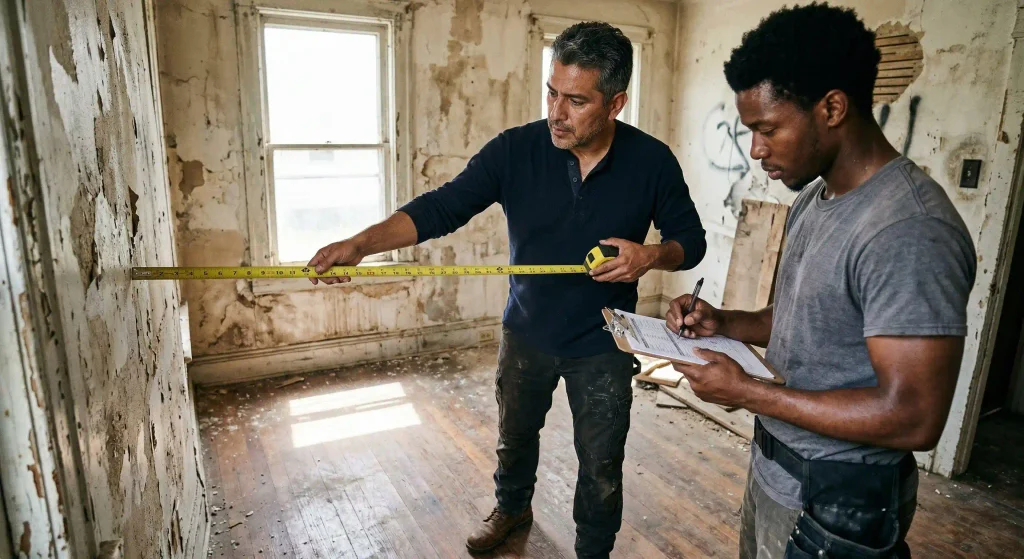
Once you have an initial ARV, estimate the repairs required to bring the property to the expected resale condition.
This step deserves careful attention. Underestimating renovation costs can make an otherwise promising deal unattractive to an end buyer.
Break the estimate into categories rather than relying on one rough number.
| Repair category | Example items |
|---|---|
| Roof | Shingles, flashing, roof replacement |
| HVAC | Heating and cooling equipment |
| Kitchen | Cabinets, countertops, appliances |
| Bathrooms | Fixtures, tile, plumbing |
| Flooring | Carpet, hardwood, tile |
| Electrical | Wiring, outlets, panels |
| Plumbing | Pipes, fixtures, water heater |
| Interior | Paint, drywall, doors |
| Exterior | Landscaping, siding, windows |
| Structural | Foundation and major structural work |
The costs will vary depending on the property’s location, size, materials, labour rates and extent of damage.
If possible, obtain contractor input or a property inspection. Photographs can help with an initial estimate, but they cannot reliably reveal every hidden issue.
Also consider a contingency for unexpected repairs. The amount should reflect the condition and uncertainty of the property rather than being treated as a universal fixed percentage.
Example: Repair estimate
| Repair item | Estimated cost |
|---|---|
| Roof repairs | $8,000 |
| Kitchen renovation | $12,000 |
| Bathroom renovation | $7,000 |
| Flooring and paint | $6,000 |
| HVAC and plumbing | $7,000 |
| Subtotal | $40,000 |
| Contingency (10%) | $4,000 |
| Estimated repairs | $44,000 |
These figures are examples, not contractor quotes or standard US repair prices.
Use our free Repair Cost Estimator
Try the EasyLife VA Repair Cost Estimator to organise your repair assumptions.
The more clearly you document the repair budget, the easier it becomes to explain the deal to a potential buyer.
Step 4: Calculate the Maximum Allowable Offer (MAO)
Now that you have an ARV and estimated repair costs, you can begin calculating your maximum allowable offer.
MAO is a pricing guideline used by real estate investors and wholesalers to estimate the maximum purchase price that may leave enough room for the buyer’s costs and required return.
One commonly used starting formula is:
MAO = ARV × Buyer’s percentage − Repair costs
A wholesaler must also account for the assignment fee when calculating the maximum amount they can offer the seller under this simplified approach:
Maximum seller offer = ARV × Buyer’s percentage − Repair costs − Assignment fee
The buyer’s percentage is not fixed. Some investors use 70% as a starting point, while others adjust their target according to the market, financing, renovation risk and expected resale costs.
The 70% rule is a rule of thumb, not a guarantee of profitability.
Example: MAO calculation
Let’s use these figures:
- ARV: $300,000
- Buyer’s percentage: 70%
- Estimated repairs: $44,000
- Desired assignment fee: $10,000
First, calculate 70% of ARV:
$300,000 × 0.70 = $210,000
Subtract estimated repairs:
$210,000 − $44,000 = $166,000
Subtract the desired assignment fee:
$166,000 − $10,000 = $156,000
Illustrative maximum seller offer: $156,000.
This is a preliminary rule-of-thumb result. It does not automatically mean a buyer can profitably purchase the property at $166,000. The buyer’s closing, holding, financing and resale costs still need to be reviewed.
Use our free MAO Calculator
You can test different percentage assumptions using the EasyLife VA MAO Calculator.
Try comparing 65%, 70% and 75% scenarios rather than relying on one percentage for every property.
Step 5: Understand Your Assignment Fee
The assignment fee is the amount a wholesaler may receive for assigning their contractual purchase rights to an end buyer, where the contract and applicable law permit that structure.
For example:
- Contract price with seller: $156,000
- Assignment fee: $10,000
- End buyer’s contract price: $166,000
In this simplified example, the difference between the seller contract price and the end buyer’s price is $10,000.
However, an assignment fee is not automatically guaranteed profit. The transaction must close, the contractual arrangement must permit the assignment, and the applicable legal and closing requirements must be satisfied.
Your fee should also leave enough room for the end buyer’s actual numbers to work.
Calculate your assignment fee
Use the EasyLife VA Assignment Fee Calculator to explore assignment fee scenarios.
Step 6: Review the End Buyer’s Actual Costs
This is where a basic wholesale calculation can become misleading.
The 70% rule is a quick screening method. It does not replace a full buyer-level analysis.
An end buyer may have additional expenses such as:
- Purchase closing costs.
- Loan origination fees and points.
- Interest payments.
- Property taxes.
- Insurance.
- Utilities.
- Renovation financing costs.
- Holding expenses.
- Selling costs and commissions.
- Unexpected repair expenses.
For example, a buyer may be comfortable with a deal at first glance but discover that a longer renovation period or expensive financing reduces the expected return.
A useful analysis separates these costs rather than hiding them inside one percentage.
Also avoid counting the same cost twice. If loan interest is entered separately, do not include that same interest again in monthly holding costs.
Step 7: Run a Complete Wholesale Deal Example
Let’s put the numbers together.
Imagine you have a property with the following estimated figures:
Property and deal assumptions
| Item | Amount |
|---|---|
| Estimated ARV | $300,000 |
| Estimated repairs | $44,000 |
| Buyer percentage | 70% |
| Desired assignment fee | $10,000 |
| Seller contract price | $150,000 |
| End buyer price | $160,000 |
Step A: Calculate the buyer’s rule-of-thumb limit
$300,000 × 70% = $210,000
$210,000 − $44,000 = $166,000
The preliminary buyer limit before other buyer costs is $166,000.
Step B: Calculate the seller offer limit
$166,000 − $10,000 = $156,000
The simplified maximum seller offer is $156,000.
Step C: Check the proposed contract price
You negotiated a seller contract price of $150,000.
Your assignment fee is $10,000.
The end buyer price is:
$150,000 + $10,000 = $160,000
This is below the preliminary $166,000 buyer limit, leaving $6,000 of room under that simplified rule-of-thumb calculation.
Step D: Don’t stop there
That $6,000 is not automatically the buyer’s profit.
The buyer still needs to account for financing, purchase closing costs, holding expenses, resale expenses and any other costs that apply to the project.
If those costs exceed the remaining room, the buyer may need a lower purchase price, a different fee arrangement or a decision not to proceed.
This is why a complete analysis is more useful than looking at the 70% rule alone.
Step 8: Compare Different MAO Scenarios
Market conditions and buyer expectations can change the numbers significantly.
Using the same ARV of $300,000, repair estimate of $44,000 and assignment fee of $10,000:
| Buyer percentage | Calculation | Seller offer limit |
|---|---|---|
| 65% | $195,000 − $44,000 − $10,000 | $141,000 |
| 70% | $210,000 − $44,000 − $10,000 | $156,000 |
| 75% | $225,000 − $44,000 − $10,000 | $171,000 |
| 80% | $240,000 − $44,000 − $10,000 | $186,000 |
These are comparison scenarios, not recommendations to use a particular percentage.
A higher percentage leaves less room for buyer costs and profit. A lower percentage provides a larger cushion but may make it harder to negotiate an acceptable offer with the seller.
The right assumption depends on the property, local market and end buyer.
Step 9: Use a Deal Analyzer to Bring Everything Together
You can calculate ARV, repairs, MAO and assignment fees separately, but managing several calculations manually can become confusing when you’re evaluating multiple properties.
A deal analyzer brings the key assumptions together so you can see how changing one figure affects the overall deal.
The free EasyLife VA Wholesale Deal Analyzer allows you to work with:
- ARV entered directly or estimated from comparable sales.
- Itemised repair costs.
- Contract price and assignment fee.
- Different MAO percentage scenarios.
- Buyer closing and selling costs.
- Holding costs.
- Optional financing assumptions.
- Estimated buyer profit and ROI.
It is designed to help you review the numbers in one place instead of switching between multiple spreadsheets.

Step 10: Prepare a Clear Deal Summary for Cash Buyers
Once the analysis is complete, organise the information so potential buyers can review it.
A useful deal summary can include:
Property information
- Address or approved marketing location.
- Bedrooms and bathrooms.
- Living area and lot size.
- Current condition.
- Occupancy status.
Financial information
- Estimated ARV.
- Comparable sale references.
- Estimated repairs.
- Contract price.
- Assignment fee.
- Total buyer acquisition price.
- Estimated closing and holding costs.
- Potential exit strategy.
Supporting information
- Current property photographs.
- Repair notes.
- Comp details.
- Access and inspection arrangements.
- Relevant contract and transaction information.
Do not present an estimated ARV as a guaranteed resale price or an early repair estimate as a contractor’s confirmed quote.
Clear, honest information helps buyers conduct their own due diligence and decide whether a deal fits their investment criteria.
Common Wholesale Deal Analysis Mistakes to Avoid
Even experienced wholesalers can make mistakes when they rush through an opportunity.
1. Overestimating ARV
Using attractive asking prices instead of relevant closed sales can inflate your expected value. Use comparable sales that genuinely reflect the subject property’s location, size and likely renovated condition.
2. Underestimating Repairs
A quick visual inspection may miss plumbing, electrical, structural or other expensive problems. Document assumptions and obtain qualified contractor input where needed.
3. Treating the 70% Rule as a Guarantee
The 70% rule is a screening guideline. It cannot replace a full assessment of financing, transaction costs, local market conditions and the buyer’s required return.
4. Ignoring Holding and Financing Costs
A renovation that takes six months instead of three can change the economics of a project. Include realistic time and financing assumptions.
5. Confusing Assignment Fee With Buyer Profit
Your assignment fee and the end buyer’s projected profit are two different figures. Keep them separate in your analysis.
6. Making Offers Without Checking Applicable Rules
Real estate wholesaling laws, licensing requirements, advertising rules and disclosure obligations can vary by state and transaction structure.
Before marketing a contractual interest or signing an agreement, check the applicable state and local requirements and consult a qualified real estate attorney when needed. Do not assume that a contract can be assigned or marketed in every situation.
Frequently Asked Questions
What is the most important number in wholesale deal analysis?
ARV is a critical starting point because it influences the buyer’s potential resale value and the maximum price they may be willing to pay. However, ARV alone cannot establish whether a deal is profitable. Repair estimates, financing, transaction costs and the buyer’s required return also matter.
How do you calculate MAO in real estate wholesaling?
A common starting formula is:
MAO = ARV × Buyer’s percentage − Repair costs.
If you are calculating the maximum amount to offer the seller while reserving an assignment fee, subtract that fee as well.
Is the 70% rule always accurate?
No. It is a rule of thumb. Actual buyer requirements differ based on the property, location, financing, renovation scope, market conditions and expected resale costs.
How many comparable sales should I use?
There is no single number that works for every market. A small set of strong, relevant comparable sales can be more useful than a large set of poorly matched properties. Start with several recent closed sales where possible, then expand the search if the local market has limited activity.
Should I include closing costs in my MAO calculation?
Yes, if you are building a more detailed buyer-level analysis. A simple 70% calculation may not separately account for every cost. Review purchase closing costs, financing, holding expenses and resale costs to understand the actual economics.
Can I analyze a wholesale deal without paid software?
Yes. You can begin with a spreadsheet and reliable property data. Free calculators can also help organise calculations and compare scenarios without immediately committing to a paid subscription.
What should I send to a cash buyer?
Provide a clear property summary, realistic ARV support, repair assumptions, contract and assignment information, photographs, access details and the relevant financial figures. Let the buyer independently verify the information.
Final Thoughts: Analyze the Numbers Before Making the Offer
A good wholesale opportunity is not simply a property with a low asking price. It is a property where the numbers, assumptions and transaction structure make sense for the seller, wholesaler and end buyer.
Take the time to verify comparable sales, estimate repairs carefully, calculate MAO and review the buyer’s complete costs. A transparent analysis can help you avoid weak deals and build stronger relationships with cash buyers.
You don’t need to pay for expensive software just to start learning the numbers. Explore the free EasyLife VA Real Estate Tools and try the Wholesale Deal Analyzer to practise with your next opportunity.
And if researching properties, organising leads, maintaining your CRM or preparing deal data is taking too much of your time, explore EasyLife VA’s real estate support services.
Analyse smarter. Stay organised. Spend more time finding and closing opportunities.
Disclaimer: This article is for educational purposes only. Calculator outputs and example figures are estimates, not appraisals, contractor quotes, financing offers, legal advice or guarantees of investment performance. Verify property information and consult qualified professionals before entering into a real estate transaction.